Showing posts with label lemon. Show all posts

Wednesday, June 27, 2018

Chicken Piccata

Chicken Piccata is one of my favorite dishes to order from a good Italian menu. Southern Living provides a great recipe for this classic chicken-lemon-caper dish.  This is an excellent recipe for Veal Piccata as well.


When I can't find thinner-cut breast cutlets, I halve a chicken breast half to make a thinner cutlet. Pound the chicken breast cutlets between 2 sheets of plastic wrap.  Pound to a thickness of 1/4 inch


Prepare the flour, seasoning with the salt and pepper, and lightly beating an white for dredging


Squeeze your lemon juice. This is the primary flavor and ingredient in the sauce.

You will also need some thinly sliced lemon rounds.


Chicken Piccata is not Chicken Piccata without these briny little flower buds.  I love capers and I prefer the smaller-sized ones. 

Measure your oil and butter for cooking the chicken, as well as butter for the sauce.


Roughly chop the parsley for the sauce.
 
After dredging in the egg white and flour, brown the chicken, two cutlets at a time. Once the first two cutlets are done, transfer to a plate and wipe the skillet clean. Repeat with the 2 more Tbsp. butter and the remaining olive oil and remaining 2 cutlets.


Transfer the final two cutlets to the holding plate.  After the last two cutlets, don't wipe out the skillet.
 

Add the chicken broth, lemon juice and capers to the skillet and bring to a boil over high heat.  Scrape up the fond on the bottom of the skillet. Add the lemon slices to the sauce. Reduce heat to medium, and simmer, whisking occasionally, for 5 minutes.


Whisk in remaining 2 tablespoons of butter.  Whisk in parsley.


Spoon sauce over chicken, and serve immediately. I served the chicken with pasta and spinach soufflé

Chicken Piccata
Adapted from Southern Living Magazine
Serves 4 

Ingredients:
4 (5 to 6 ounces) boneless, skinless chicken breast cutlets (or 2 breast halves, sliced to make 2 thinner cutlets)
1/2 cup all-purpose flour
1-1/2 tsps. kosher salt
1/4 tsp. black pepper
1 large egg white, lightly beaten
6 Tbsp. salted butter, divided
2 Tbsp. olive oil, divided
1 cup chicken broth
1/4 cup fresh lemon juice
2 Tbsp. brined capers, drained and rinsed
1/3 cup chopped fresh flat-leaf parsley

Mise en Place:
  • flatten chicken cutlets
  • prepare flour seasoned with the salt & pepper and egg white in dredging dishes
  • measure butter and olive oil for divided uses
  • measure chicken broth
  • squeeze fresh lemon juice
  • slice some thin slices of lemon
  • drain and rinse capers
  • chop parsley
Method:
Place each chicken cutlet between two sheets of plastic wrap and flatten to 1/4-inch thickness using a meat mallet or rolling pin.  Dip each cutlet in the egg white and dredge in the flour mixture, shaking off any excess.

Melt 2 Tbsp. butter with 1 Tbsp. olive oil in a large cast-iron skillet over medium-high heat. Add 2 cutlets and cook until golden brown, 2 to 3 minutes on each side. Transfer to a plate. Wipe skillet clean and repeat process with 2 Tbsp. butter and remaining 1 Tbsp. olive oil and remaining 2 cutlets.  Move the cutlets to the holding plate. discard drippings but do not wipe skillet clean.

Add chicken broth, lemon juice, and capers to skillet. Bring to a boil over high heat, stirring and scraping bottom of skillet to loosen the browned bits (fond). add thin lemon slices. Reduce heat to medium and simmer, whisking occasionally, 5 minutes.  Whisk in remaining 2 Tbsp. butter. Whisk in parsley. Spoon sauce over chicken and serve immediately with pasta. 

Tuesday, December 5, 2017

Lemon Spaghetti

This is a wonderfully light and bright dish to make as a side or an entreé.  Most of the time Lovey and I make this as an entreé and serve with a grilled chicken breast or poached fish.

It is so simple and easy to throw together and although it only takes minutes to prepare you can still make the sauce ahead of time, set in the refrigerator for up to 8 hours so all you have to do at dinner time is boil your water for the pasta.


Ingredients are few.  You have spaghetti (naturally), grated fresh Parmesan Reggiano, olive oil, lemon juice, salt and pepper


Simply throw the olive oil, lemon juice, Parmesan, and salt and pepper into a large enough mixing bowl to easily toss a pound of cooked spaghetti.  Set that aside.


When I think of it I'll toss one of the juiced lemon halves and a basil stem into the salted water.  


Drain and pour into mixing bowl that has the sauce.  Sprinkle with the lemon zest.  At this point you may also add chopped basil if you choose to use.  Toss to coat the spaghetti and season to taste, if needed. Add some of the reserved cooking liquid from the spaghetti at this point.


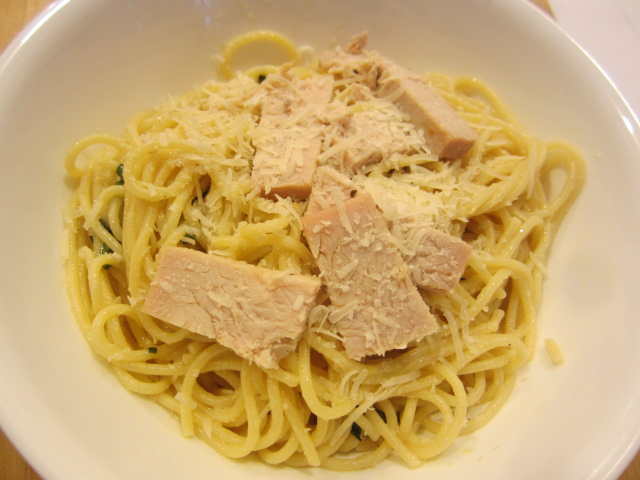
If this is going to be the main dish you can serve as is...


or top the spaghetti with the sliced grilled chicken breast...


or poached cod.


Lemon Spaghetti
Adapted from Everyday Italian by Giada de Laurentiis
Serves 4 as a main dish or 6 as a side dish

Ingredients:
2/3 cup freshly grated Parmesan
2/3 cup extra virgin olive oil
1/2 cup freshly squeezed lemon juice (about 2 lemons)
3/4 tsp. kosher salt, plus more to taste
1/2 tsp. freshly ground black pepper, plus more to taste
1 pound dried spaghetti
1/3 cup chopped fresh basil (optional)
1 Tbsp. grated lemon zest (from about 2 lemons)

Mise en Place:
  • grate Parmesan
  • grate zest from lemons
  • squeeze juice from lemons
  • chop or chiffonade the basil if using

Method:
In a large mixing bowl mix together the Parmesan, olive oil, lemon juice and salt and pepper.  Whisk together and set aside.  NOTE:  If you make this sauce ahead of time mix in a smaller bowl, cover with plastic wrap then store in refrigerator for up to 8 hours.  Bring the sauce to room temperature before using.

Bring a large pot of salted water to a rolling boil.  Add the spaghetti and cook, stirring occasionally, until tender but still firm to the bite, about 8 minutes.

Drain, reserving 1 cup of the cooking liquid. Add the spaghetti to the bowl lemon sauce, toss with the lemon zest (and basil if you are using). Toss the pasta with enough of the reserved cooking liquid, 1/4 cup at a time, to moisten.

Season with additional salt and pepper if desired. Transfer to bowls and serve.

Serving Options: Top with sliced, grilled chicken breast or poached or sauteéd fish such as salmon or cod.

Monday, May 7, 2012

Strawberry-Lemon Sheet Cake

There are some flavors that were made for each other.  Strawberry and lemon are two of those in my opinion.   I ran across this Strawberry-Lemon cake in "the box".  It's from a June 2004 issue of Southern Living.


Here are the cast of characters for the cake


 and the cast of characters for the strawberry sauce

I made the strawberry sauce the night before I needed it.


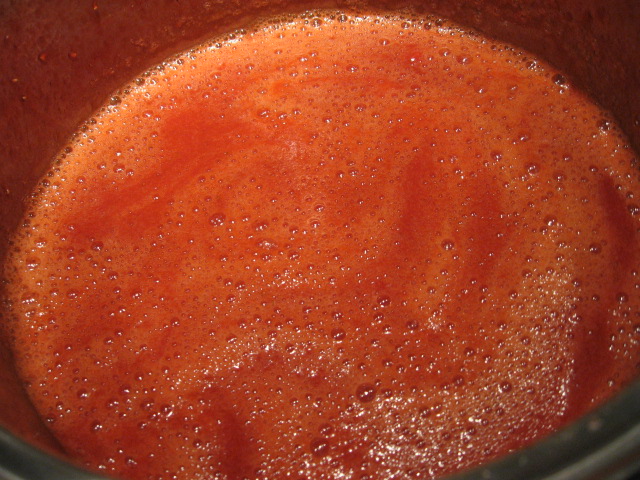
After I cooked down my strawberries, they were still quite chunky so I took an immersion blender to the fruit.


That smoothed it up nicely for me.


Placing a piece of wax paper or plastic wrap will keep the sauce from forming a skin.  I put it in the refrigerator and let it set over night.  You will need to take a whisk to it the next morning before you use it.

The strawberry-lemon filling turned out tasty.  The strawberry was definitely winning out in the flavor department but I was able to detect a little tang of lemon.  Not quite as lemony as I would have liked.

The cake is a thin sheet cake that had a sponge cake texture to it.  After letting the cake completely cool (1st in the pan then on a cooling rack), I turned it out onto a large cutting board and quartered it (you can 1/2 it if you prefer).  Upon taking a little nibble of the cake I didn't think the cake had any lemon taste to it (it only called for 1 tablespoon of lemon juice and 1 tablespoon of lemon rind).


I decided more lemon was needed so I mixed up a lemon glaze and spread on the cake layers prior to spreading the strawberry-lemon filling.

That was definitely the right choice for lemon flavor.


But, maybe not so much on the engineering front.  Laugh as you will.  I did.  The goal of this site was never to perfect the recipe then post it. 

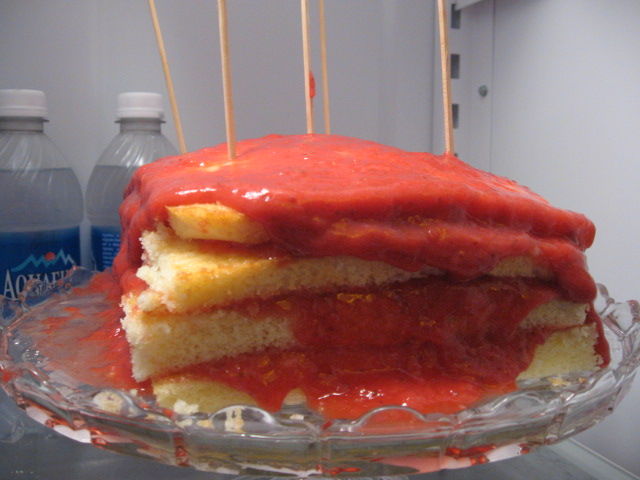
The glaze put a bit of a slick surface on each cake layer once it was dried. I spread a layer of strawberry filling on top of the glaze and once the second layer was laid on top it proceeded to slide like a slow avalanche.

Several skewers solved the problem and once the cake was placed back in the refrigerator the filling firmed up, and the cake was once again stable and I was able to work the layers back on top of each other.  Covered in whipped cream, you'd never know it was a near disaster!


Sliced up and plated the layers were very pretty and the cake was really tasty. 

Thoughts and Notes:
■  Mix this cake batter by hand for a more tender and moist cake.
■  Even with all the construction flaws this is a good tasting recipe once the extra lemon element was added.  I think it would have been blah without the lemon glaze.
■  This recipe would be easier to manage made into individual 2-layer mini-cakes by cutting the sponge cake out with a 3"- 4" round cookie cutter or some other geometric shape.
■  I don't know if the lemon glaze had anything to do with the slipping and sliding, but I'd do it again because the cake desperately needed more lemon.
■  The next go 'round (yes, I will address this cake again) we'll try the minis and possibly baking the cake in a smaller pan so it's thicker and the layers can be shaved flat on top (this was too thin to trim any off the top).


Strawberry-Lemon Cake
Adapted from a recipe by Angie Beachy of Lusby, Maryland and featured in the June 2004 issue of Southern Living


For the Strawberry-Lemon Filling
Ingredients:
1 (16 ounce) package whole frozen strawberries
6 Tbsp sugar, divided
1/4 cup fresh lemon juice
1/4 cup all-purpose flour

Mise en place:
  • measure and divide sugar
  • squeeze lemon juice
  • measure flour
Method:
Bring strawberries, 4 Tbsp of the sugar, and the lemon juice to a boil i a medium saucepan, and cook 5 minutes.

If your strawberries are very chunky use an immersible blender to make the filling smooth.

Whisk together remaining 2 Tbsp of sugar and the flour in a saucepan.  Whisk in strawberry mixture; cook over medium heat 5 minutes or until thickened and bubbling around edges.  Pour into a glass bowl, cover surface with plastic wrap or wax paper; chill at least 2 hours or over night.

For the cake
Ingredients:
2 cups cake flour
1-1/2 cups sugar
2 teaspoon baking powder
1/2 teaspoon salt
3 large eggs
3/4 cup whole milk
1/2 cup vegetable oil
1/4 cup butter, melted
1 tablespoon grated lemon rind
1 tablespoon fresh lemon juice

Mise en place:
  • melt butter and allow to cool
  • grate lemon rind
  • squeeze lemon juice
  • break eggs into a medium mixing bowl
  • measure out milk & oil
  • measure out flour, sugar, baking powder and salt into a large mixing bowl & whisk together
Method:
Line a lightly greased 15" x 10" jellyroll pan with parchment paper; lightly grease the parchment paper.  Preheat oven to 350°F.

Add the cooled butter, milk, oil, lemon rind and lemon juice into the mixing bowl with the eggs and whisk together until blended.

Whisk into dry ingredients just until blended.  Pour batter into prepared pan.

Bake at 350°F for 30 minutes or until wooden pick inserted in center comes out clean.  Cool cake in pan on wire rack 10 minutes.  Invert cake onto a wire rack, and remove parchment paper; let cool completely.  Transfer cake to a large cutting board.

For the Lemon Glaze
Ingredients:
1-1/2 cup powdered sugar
3 Tbsp fresh lemon juice
zest of one lemon

Mise en place
  • measure out powdered sugar into small mixing bowl
  • zest the lemon
  • juice the lemon
Method:
Using a whisk, mix all three ingredients until well combined.

For the Whipping Cream
Ingredients:
1-1/2 cups heavy whipping cream
6 Tbsp sugar

Method:
Beat whipping cream and sugar at high speed with an electric mixer until stiff peaks form.  Refrigerate.

Assembly
Cut sheet cake in quarters to create rectangles.  Divide the lemon glaze among the 4 layers, allowing to drip down sides slightly.  Place bottom layer on serving plate.  Spread filling on bottom layer.  Place second layer on top of bottom layer; spread filling on top of second layer; repeat this process with last two layers.  Secure with skewers stuck through the top of the cake, if necessary.  Refrigerate while you make the whipping cream.

To frost this cake you can simply spread the whipped cream on the sides and top of the cake, or just the sides.  You can also spoon the whipped cream into a pastry bag and decoratively pipe around the sides of the cake, leaving the top un-covered showing off the bright red filling.

Wednesday, March 14, 2012

Moroccan Preserved Lemons

I started making my own preserved lemons after watching an episode of Ruth Reichl's Gourmet’s Adventures with Ruth which ran on our PBS station a few years ago.  It was during the episode where she traveled to Morocco that I was schooled on this tangy condiment.  I use them a lot in salads and in chicken dishes.  They are so easy to make and it's nice to have them at your fingertips.


This is how I learned to make them.

The containers.

Select your container or containers, depending on how much you plan to make.  I prefer glass jars (clamp/gasket or Ball jars).  Wash and sterilize them.  I scrub mine by hand then boil them in a large pot of water for about 10 minutes.


Unless I am making gifts, I make just one jar to keep in the fridge.  Once my jar is clean and dry I toss a little kosher salt into the bottom of it.


The lemons.

Any lemon will do but choose unwaxed organic lemons.  I prefer Meyer Lemons with their deep yellowy-orange skin that's thin and fragrant.  It's juice is also a little sweeter and less acidic than a true lemon.  Select enough lemons to cram the jar full.  You'll want to buy extra lemons for juicing as well. 


Scrub your lemons clean.  This is what I use to clean most of my fruits and vegetables.


Cut each lemon through the center 3/4 of the way through making sure to keep intact.  Turn a half turn and make another slice 3/4 of the way through the lemon.


The lemon should look like this.  You'll have a quartered lemon that is still attached at the base.


Have a bowl full of kosher salt on hand and start packing your lemon with the salt.  As you finish packing a lemon, place it in the jar.


Repeat with the rest of the lemons until you have crammed the jar full.  As you stuff the lemons in the jar, you will want them packed in really tight and compress them so you release juices.


Over time, juices will naturally begin to release themselves but you will want to juice several lemons and pour the juice into the jar.


I also added a couple of sprigs of fresh thyme I had on hand.


The lemons can be stored on a shelf in a dark cool closet but I prefer the refrigerator.  Every two to three days for the first week, open the jar and compress the lemons, releasing more juice.  After a week, if the lemons are not completely submerged in the juices, juice another lemon or two and add the juice to the jar.

Walk off and forget about the lemons.  I don't even think about them for at least two months.

Uses:
  • remove the soft rind and mince it to add to salads
  • separate the rind and pulp and smear all over a roasting chicken and throw some inside the chicken too.
  • the rinds can be used in sauces (whole or chopped up)
  • you can use your lemons to flavor any savory dish
  • give them as gifts

Moroccan Preserved Lemons
The ingredients will vary depending on the size of your jar, the size of the lemons and how many jars you plan to make.  For the sake of giving you a guideline, I'm giving you the ingredients I used to fill a 2 cup gasket and hinge jar.

Ingredients:
8 Meyer Lemons, divided
1 cup Kosher Salt (you won't use all of this but it's better to have alot on hand than not enough!)
Fresh herb sprigs (optional)

Mise en Place:
  • Scrub jar and boil (without the gasket on) in a large pot of water (enough water to cover jar) for about 10 minutes - dry thoroughly
  • wash lemons and set aside
  • squeeze lemon juice from 2 of the lemons
  • pour salt in small mixing bowl
Method:
Drop a good pinch of salt in the bottom of the jar.

Slice 6 of the lemons in quarters 3/4 of the way through - all 4 sections should stay intact.

Take fingerfuls of salt and pack into the lemon.  Place into the jar.  Repeat with each lemon and as you pack them into the jar, use pressure to compress the lemons together and exude juices.  Once you have packed your jar full (I packed 6 lemons into my jar) slip in whatever herb you like (if you choose to use an herb at all).  Pour the lemon juice that you squeezed from the 2 lemons into the jar.

Replace gasket onto the jar lid the clamp the jar closed.  Place in refrigerator.  Every 2 to3 days, open the jar and give the lemons a squeeze to exude more juice.  After a week, if the lemons are not submerged in juice, add more freshly squeezed lemon juice.

Forget about the lemons for a couple of months and let nature take its course.

Sunday, March 4, 2012

Avgolemono

It's all about citrus at I Heart Cooking Clubs this week.  I selected smooth, puckery and yummy Avgolemono; that's chicken soup with egg and lemon.  The first time I ever tasted this soup was in 1982.  Lovey and I were visiting a high school friend, Victoria, who was living in Monument, Colorado.  The grandmother of the man she was married to at the time was from Greece and she showed Vicki how to make this soup.  We were sitting in her kitchen watching her create this soup and I had never seen or heard of anything like it.  It was so tasty we could have eaten the whole pot!  Actually, I think we did; in that one sitting.

I've had Avgolemono many time since and although Vicki gave me the recipe way back then, this is the first time I have ever made this soup.  And I'm not using Vicki's, but Tessa Kiros' recipe from her Falling Cloudberries cookbook.

The main work, time and effort is to poach your chicken.


Rinse your chicken and place it in a large pot with and onion, celery stalk that has lots of leaves, a carrot, salt and a couple of peppercorns.  These vegetables are going to be tossed so there's no reason to peel the carrot or onion.  You do want to make sure they are clean though; and I do slice off the ends of the onion.


Cover with water and bring to a boil.  Turn down the heat and simmer and about an hour and a half.  With a slotted spoon, skim the surface periodically.

When the chicken is done, remove to a plate and set aside.


Strain the broth through a sieve then press the vegetables with the back of a spoon so you don't miss all the yummy flavor the vegetables have to offer. 

Return the broth to the pot and add the rice.  Cook until the rice is done. 

Lastly, you add the magic.  But it's simple magic.  Just whip two eggs in a small bowl until they are light and fluffy.  Add the juice from two lemons and whisk together.  Temper the egg mixture by drizzling a ladle full of the hot broth into the eggs while whisking.  When I'm tempering an egg mixture like this I usually use several ladlefuls to make sure the mixture is warmed up enough to add to the pot.

Stir the tempered egg mixture back into the pot and enjoy the creaminess of this rich, delicious soup.  I put some shredded chicken in the bottom of our bowls then ladled the soup on top.

Tessa comments that you could easily add some thyme sprigs or other herbs to inauthentically infuse the broth of this classic Greek soup.


Avgolemono (Chicken Soup with Egg and Lemon)
Adapted from Tessa Kiros' Falling Cloudberries

Ingredients:
1 (3 pound) whole chicken
1 white onion
1 celery stalk with leaves
1 large carrot
a few parsley stalks
a few black peppercorns
1-1/2cup long-grain rice, rinsed
2 eggs
juice of 2 lemons

MIse en place
  • rinse chicken
  • clean vegetables
  • measure out rice
  • crack eggs into small mixing bowl
  • juice 2 lemons
Method
Place chicken in a large stockpot with the onion, celery, carrot, parsley stalks, peppercorns and a good sprinkling of salt.  Cover with about 14 cups of cold water and bring to a boil.  Skim the surface with a slotted spoon, decrease the heat, and simmer, uncovered, for about 1-1/2 hours, skimming occasionally.  Lift the chicken out onto a plate with a slotted spoon.  Strain the broth through a sieve, pressing down lightly on the vegetables with your wooden spoon to extract the flavor.  You should have about 6 cups of broth.  Return this to the saucepan, add the rice and cook over medium heat for another 15 minutes or so, until the rice is cooked.

Whisk the eggs until they are fluffy.  Add the lemon juice.  Add a ladleful of hot broth to the egg, whisking to stop it from scrambling.  Whisk in a little more broth, then add the entire egg mixture to the pan.  Return the saucepan to the lowest possible heat for a few minutes to warm the egg through.  Add some salt and pepper and serve immediately.  If you like, shred one of the chicken breasts and scatter over the soup.  Serve the rest of the chicken as a second course.

I'm sharing this at IHCC.